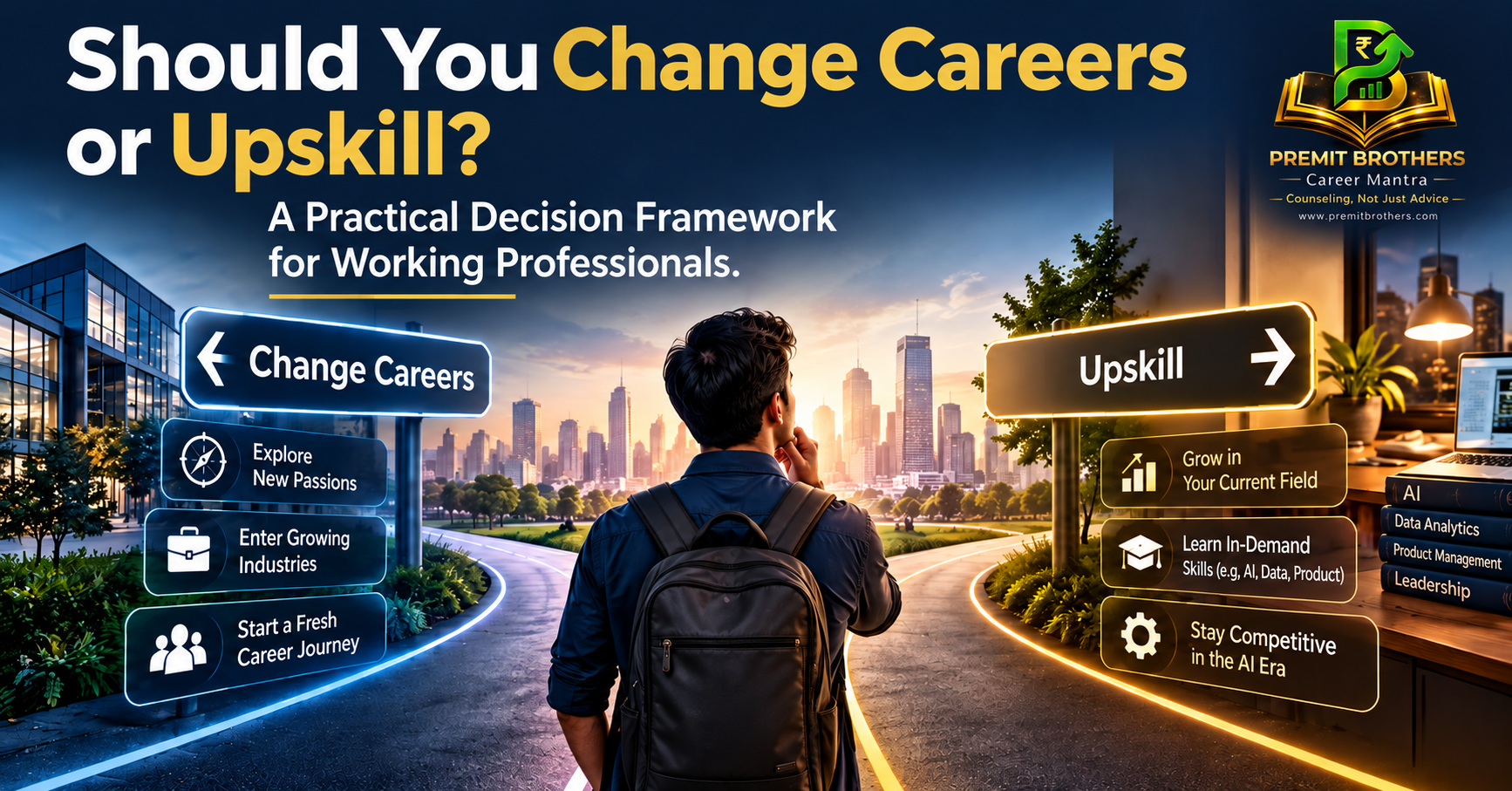
A difficult week, disappointing appraisal, new AI tool, or someone else’s career-change announcement can make a complete switch look attractive. But “I need a new career” is often a conclusion reached before the real problem has been diagnosed.
For one professional, the issue may genuinely be the nature of the work. For another, the profession may be fine but the employer is wrong. Someone else may need a stronger skill stack, a more relevant role, or a better way to use years of existing experience.
That distinction matters because a career switch can affect income, identity, family responsibilities, learning time and professional seniority. The goal is to make the smallest change that solves the real problem — and a bigger change when the evidence justifies it.
First Ask: What Exactly Is Not Working?
1. Is it a role problem?
Think about the work you perform repeatedly. Do you dislike the core tasks even on relatively good days? Write down the five activities that consume most of your working week. Mark each as energising, neutral or draining. Patterns are more useful than a vague statement such as “I hate my job.”
2. Is it an employer or environment problem?
A poor manager, long commute, unpredictable hours, limited autonomy, unhealthy culture or weak compensation can make an otherwise suitable profession feel wrong. Ask: “If I did broadly similar work in a healthier environment, would I still want to leave?” If the answer is no, test a job change before abandoning accumulated career capital.
3. Is it a skill-gap problem?
Technology changes how work gets done. Current 2026 reporting shows strong interest among experienced professionals in applied AI learning, while professional programmes increasingly focus on using AI in real work rather than treating it only as an academic subject.
That does not mean everybody needs an “AI career.” A finance professional may need stronger analytics and AI-assisted workflow skills; a marketer may need better experimentation and automation capability; a manager may need to understand how AI changes team processes. Ask whether your field is wrong for you, or your current skill stack is becoming less competitive inside a field that still fits.
4. Is it a growth-ceiling problem?
You may enjoy the work but dislike where the path leads. Perhaps the next level requires people management when you prefer specialist work, progression is narrow in your location, or the compensation structure does not fit your goals. This may call for an adjacent pivot where existing knowledge still matters.
5. Is it a fit or values problem?
A deeper switch becomes more reasonable when the fundamental work conflicts with your strengths, interests, preferred lifestyle or values. Competence answers “Can I do it?” Career fit also asks “Do I want the life and work pattern that come with doing it repeatedly?”
The PB Three-Path Decision: Stay, Pivot or Switch
Path A: Stay and Upskill
This path makes sense when the underlying field still fits but your skills, tools or responsibilities need to evolve. A useful upskilling plan connects learning to work. Instead of collecting certificates, identify a capability gap, learn enough to use it, produce evidence of application and see whether it improves your opportunities.
Path B: Make an Adjacent Pivot
An adjacent pivot changes the role while preserving useful career capital. A domain expert may move toward consulting, product, analytics, training, customer success or another function where existing industry knowledge remains valuable. Ask what knowledge remains valuable, which capabilities transfer, which gaps genuinely need filling, and whether you can demonstrate the new capability before changing jobs.
Path C: Make a Full Career Switch
A larger switch becomes more defensible when the core work itself is a poor fit, the desired destination has been explored realistically, and the transition is financially and practically manageable. Compare the destination’s ordinary work, learning curve, lifestyle, entry requirements and downside — not only its most attractive success stories.
Use the Five-Evidence Test Before Committing
Evidence 1: Task fit
Read real job descriptions and speak with people doing the work. What do they actually spend time on?
Evidence 2: Capability fit
Separate transferable skills from missing skills. A new job title does not make you a beginner in everything.
Evidence 3: Exposure
Try a small project, shadowing opportunity, simulation or portfolio task where appropriate. Experience the work rather than merely imagining it.
Evidence 4: Market reality
Study current job descriptions across several employers. Look for recurring requirements rather than treating one vacancy as the market.
Evidence 5: Life feasibility
Estimate learning time, financial runway, possible temporary income effects, location constraints and family responsibilities. An attractive path that cannot fit your current life needs a different transition design.
A Simple Career Decision Scorecard
Score each option from 1 to 5 on: interest in daily work; strength/capability fit; transferable career capital; learning gap; market evidence; lifestyle fit; financial feasibility; and willingness to practise the required skills over time.
Do not blindly select the highest total. Use the scorecard to expose disagreements in your thinking. A new career may score 5 on excitement but 2 on exposure because you have never actually done the work. That is not a reason to reject it. It is a reason to run an experiment before committing.
The 30-Day Career Experiment
Week 1: Diagnose
Document what you want to leave and what you want more of. Separate job, employer, skill, growth and fit problems.
Week 2: Investigate
Choose no more than three realistic paths. Review job descriptions and credible learning requirements. Speak with people in the work when possible.
Week 3: Test
Complete one small task that resembles the target work. If considering analytics, analyse a public dataset. If considering product management, practise breaking down a user problem and prioritising solutions. The purpose is evidence, not perfection.
Week 4: Decide the next experiment
You do not need to decide your entire career in 30 days. Decide whether the evidence supports deeper upskilling, an adjacent pivot, full-switch exploration, or staying while fixing the actual problem.
What AI Changes — and What It Does Not
AI makes this decision feel urgent because tools and workflows are changing quickly. Current reporting in India shows experienced professionals actively pursuing applied AI learning, including executive and professional programmes.
But urgency should not become panic. AI can change tasks inside a profession without making the entire profession unsuitable for you. Domain knowledge, judgement, communication, relationships and understanding of real problems can remain valuable while tools evolve.
For many professionals, the sensible response may be “domain expertise + new capability,” not “erase my past and become an AI specialist.”
Common Mistakes to Avoid
Switching because a field is trending
A growing field can still be a poor personal fit.
Buying a course before choosing a problem
A course is useful when it closes a defined gap. It is a weak substitute for career diagnosis.
Treating your experience as sunk cost
Past experience should not imprison you, but it should be inventoried. Industry knowledge, stakeholder management, communication, sales, operations, analysis and leadership may transfer.
Comparing your beginning with someone else’s announcement
Career-change stories often compress years of context into a post. Base your decision on your own constraints and evidence.
When Career Counselling Can Help
A framework cannot make the decision for you. Its job is to make the decision clearer.
If you keep circling between several options, struggle to distinguish dissatisfaction from poor career fit, or cannot objectively weigh strengths, interests, constraints and opportunities, structured career counselling can help organise the evidence.
Premit Brothers works with individuals to move from confusion toward an informed career strategy. The useful outcome is not being told a fashionable job title. It is understanding your decision factors, testing realistic paths and building a practical next-step plan.
FAQ
Should I change careers if I feel stuck?
Feeling stuck is a signal to investigate, not proof that the profession is wrong. Diagnose whether the problem is the role, employer, skill stack, growth path or fundamental fit.
Is upskilling better than changing careers?
Neither is universally better. Upskilling is usually the smaller intervention when the field still fits. A larger switch becomes more reasonable when the core work or long-term path is the problem and an alternative has been tested.
Can I explore a career change while employed?
Often, yes. Informational conversations, job-description research, portfolio experiments and targeted learning can generate useful evidence before a major transition, subject to your employment terms and responsibilities.
Do I need to move into AI to stay relevant?
Not necessarily. AI is changing many workflows, but the right response depends on your field and role. For many professionals, learning relevant AI capabilities within existing domain expertise may be more useful than changing professions solely because AI is trending.