PB Career Mantra | Confusion to Conclusion
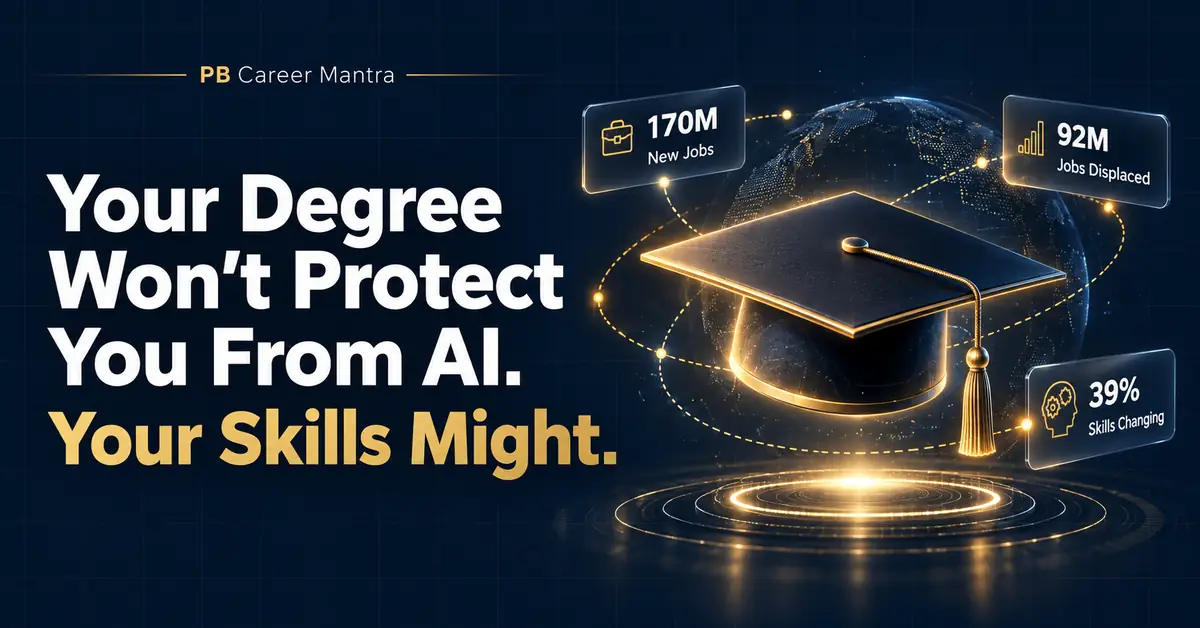
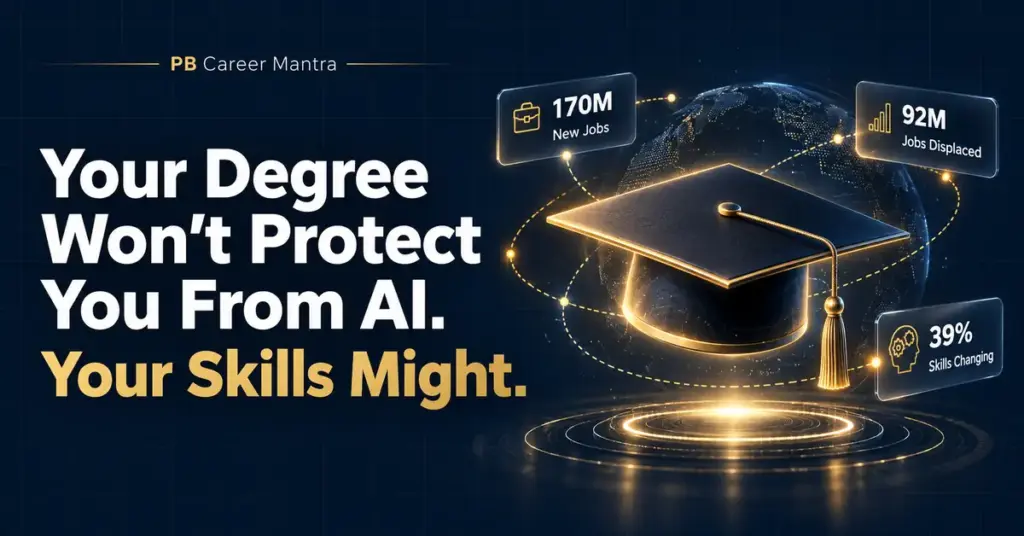
Your Degree Won’t Protect You From AI. Your Skills Might.
170 Million New Jobs. 92 Million Disappearing. Which Side Will Your Child Be On?
The world of work is being rewritten. Yet most Indian families are still following a 1990s career formula: marks, degree, job. Here is what has changed, and what students must do about it.
AI Is Here
AI is not replacing whole careers overnight. It is replacing tasks, and fast.
Skills Decide
Employers now hire for what you can do, not just what you studied.
Clarity Wins
The safest career is the one built around your real strengths.
For decades, Indian parents made their children one simple promise.
Study hard. Score well. Get a good degree. A good job will follow.
It was a reasonable promise. For a long time, it even worked. A degree was a ticket, and the ticket guaranteed a seat.
That promise is now breaking.
Not because education has become useless. But because the world that education was preparing students for has changed faster than our classrooms, our coaching centres and our family conversations.
Artificial intelligence can now write, calculate, summarise, design, code and analyse at a speed no human can match. Companies are redesigning roles. Entry-level work is being automated first. And recruiters are asking a new question.
The old question was: What degree do you have?
The new question is: What can you actually do, and can you keep learning as the work changes?
This blog is for every student who is choosing a stream, a course or a first job, and for every parent who is quietly worried whether the lakhs being spent on education will really secure their child’s future.
At PB Career Mantra, we believe the answer is not panic. The answer is clarity.
The Graduate Paradox: More Degrees, Fewer Ready Candidates
Here is a fact that surprises most families.
According to the ILO’s India Employment Report 2024, the unemployment rate among young graduates in India was about 29.1% in 2022. Among young people who could not read or write, it was about 3.4%.
Read that again. In India, a young graduate was far more likely to be unemployed than a young person with no formal education at all.
That does not mean education is a mistake. It means many graduates are trained for jobs that are shrinking, while the jobs that are growing need skills their degree never gave them. Many are also waiting for “the right job” while lacking the practical skills to create or win one.
Unemployment among young graduates in India (ILO, 2022 data)
Of Indian youth assessed found employable (India Skills Report 2026)
Still not job-ready, despite years of study and fees
The India Skills Report 2026 places overall employability at around 56.35%. It is improving, and that is good news. But it also means that nearly four in ten young Indians are still not considered job-ready.
Behind every percentage is a family that invested money, time and hope, and a student who did everything “right” but still feels stuck.
For Students & Parents
Not sure which stream, course or career is future-proof?
Start with clarity. Understand strengths, aptitude, personality and the career pathways that are actually growing.
AI Is Not Taking Jobs. It Is Taking Tasks.
Most headlines about AI are either scary or exaggerated. The reality is more useful to understand.
The World Economic Forum’s Future of Jobs Report 2025 estimates that between 2025 and 2030, about 170 million new jobs will be created worldwide, while about 92 million will be displaced. That is a net gain of roughly 78 million jobs.
So the future is not jobless. But it will be very different.
The same report estimates that about 39% of workers’ core skills are expected to change by 2030. Nearly four out of every ten skills a professional relies on today may be outdated, transformed or replaced within five years.
AI is very good at routine, repeatable, rule-based tasks:
Many entry-level roles were built on exactly these tasks. That is why fresh graduates feel the pressure first.
A student who spends four years memorising what AI can now do in four seconds is not being prepared for the future. They are being prepared for the past.
This is the question lakhs of graduates are asking today. The problem is that they are asking it after the degree, when the answer should have been planned before it.
The Skills the Future Will Actually Pay For
If routine tasks are being automated, what will employers value more?
The WEF report lists analytical thinking as the most important core skill for employers. It also names AI and big data, technological literacy, creative thinking, resilience and flexibility, and curiosity and lifelong learning among the fastest-rising skills.
Notice something important. The list mixes technical skills with deeply human skills. The future does not belong only to coders. It belongs to people who can think, adapt and work with technology.
None of these appear on a marksheet. Yet each of them decides who gets hired, who gets promoted and who gets left behind.
This is why we say at PB Career Mantra: AI will not replace people. People who use AI well will replace people who do not.
The Real Danger Is Not AI. It Is Herd Thinking.
Every year, lakhs of students choose careers the same way.
A relative’s son did engineering. A neighbour’s daughter cleared a government exam. A cousin is “doing well” in IT. So the same path gets chosen again, without asking whether it fits this particular child.
Herd-Based Choice
- “Everyone is doing it”
- Driven by relatives’ advice
- Ignores aptitude and interest
- Degree first, skills later (or never)
- Plan A only, no backup
Clarity-Based Choice
- “This fits who I am”
- Based on psychometric insight
- Matches strengths to growing fields
- Degree and skills built together
- Clear Plan A, B and C
In a stable world, herd thinking was merely inefficient. In an AI-driven world, it is dangerous.
When a whole crowd rushes towards the same career, two things happen. Competition becomes brutal. And when that field gets disrupted, the whole crowd gets hit at once.
A student who chooses a path because it matches their interests, aptitude and personality is far more likely to stay motivated, keep upskilling and adapt when the industry changes.
Stop Collecting Certificates. Build a Career Stack.
As a financial professional, I often compare careers to investment portfolios.
No sensible investor puts all their money into one stock. Why do we put a child’s entire future into one degree?
A future-ready career is not a single certificate. It is a stack of layers that support each other. If one layer is disrupted, the others keep the career standing.
The degree gives foundation and credibility. A core skill such as data analysis, design, sales, writing or a trade gives employability. AI fluency multiplies productivity. Communication gets ideas heard. Real projects and internships prove ability. Adaptability keeps the whole stack relevant.
A B.Com graduate who also knows financial modelling, uses AI tools confidently and can present to a client is not competing with lakhs of other B.Com graduates. They are in a category of their own.
Skills are not a replacement for education. Skills are what make education valuable.
PB Career Mantra
Stop guessing. Start understanding.
Build a Career Around Strengths, Skills and Clarity.
A Future-Proof Career Roadmap, Stage by Stage
Career clarity is not a one-time decision in Class 12. It is a process that should start early and keep evolving.
Discover interests and aptitude. Explore widely through hobbies, sports, clubs and a psychometric assessment before stream selection.
Choose the stream and target courses based on data, not pressure. Start one real skill alongside academics.
Build the stack: internships, projects, AI tools, communication and a portfolio that proves what you can do.
Reskill every year. Track where your industry is heading and move before disruption forces you to.
The earlier this process begins, the cheaper and calmer it is. A wrong stream choice in Class 11 can cost years. A wrong degree can cost lakhs. A few hours of structured clarity can prevent both.
What Parents Can Start Doing This Week
Parents do not need to become AI experts. But they do need to change the questions they ask.
- Ask “What are you good at and enjoy?” before asking “What are your marks?”
- Notice what your child does without being told: build, draw, argue, organise, explain, fix
- Treat skill courses, sports and projects as investments, not distractions
- Encourage your child to use AI tools to learn, not just to finish homework
- Stop comparing your child’s path with relatives’ children
- Get an objective psychometric assessment before choosing a stream or course
- Plan a Plan B and Plan C, not just a Plan A
- Celebrate learning and effort, not only results
The biggest gift a parent can give today is not the most expensive coaching. It is the confidence of a child who knows their strengths and has a clear direction.
AI Won’t Replace Your Child. Confusion Might.
Technology has always changed work. The printing press did. Computers did. The internet did. Each time, people who adapted did better, and people who waited struggled.
AI is simply the fastest version of that story. So before choosing the next course, the next exam or the next coaching class, it is worth asking a few honest questions.
Are we choosing this career because it fits, or because everyone else is choosing it?
Does our child know their real strengths, or only their marks?
Is this degree being paired with skills the market is actually hiring for?
Is our child learning to use AI, or only competing against it?
Do we have a Plan B if this industry changes in five years?
Are we preparing our child for the future, or for the past?
The students who will thrive in the next decade are not necessarily the ones with the highest marks. They are the ones who understand themselves, build the right skills early, and keep learning.
A degree opens the door. Skills and clarity decide how far you walk.
Stop guessing. Start understanding.
Build a future-proof career around strengths and skills, not just a degree.
PB Career Mantra
Confusion to Conclusion
If you are unsure about stream selection, course choice, a career switch or how to future-proof your child’s career in the age of AI, PB Career Mantra can help you decide with confidence through psychometric assessment, structured counselling and a personalised career roadmap.
— Dr. Amit Premit
Career & Growth Strategist
Premit Brothers
Frequently Asked Questions
Will AI take away jobs in India?
AI will automate many routine tasks, especially in entry-level roles. But global estimates, such as the WEF Future of Jobs Report 2025, suggest more jobs will be created than displaced by 2030. The key is to build skills that complement AI rather than compete with it.
Is a degree still important for a career?
Yes. A degree provides foundation and credibility. But on its own it is no longer enough. Students should combine their degree with practical skills, AI fluency, communication, projects and internships.
Which skills are most important for future jobs?
Analytical thinking, AI and big data, technological literacy, creative thinking, resilience, flexibility, curiosity and lifelong learning are among the most in-demand skills, along with communication and problem-solving.
How can a psychometric test help in career selection?
A psychometric assessment objectively measures interests, aptitude, personality and learning style. It helps students and parents choose streams, courses and careers based on data rather than guesswork or peer pressure.
When should a student start career planning?
Ideally from Class 8 to 10, before stream selection. However, career clarity is valuable at every stage, including after Class 12, during college, after graduation and while working.