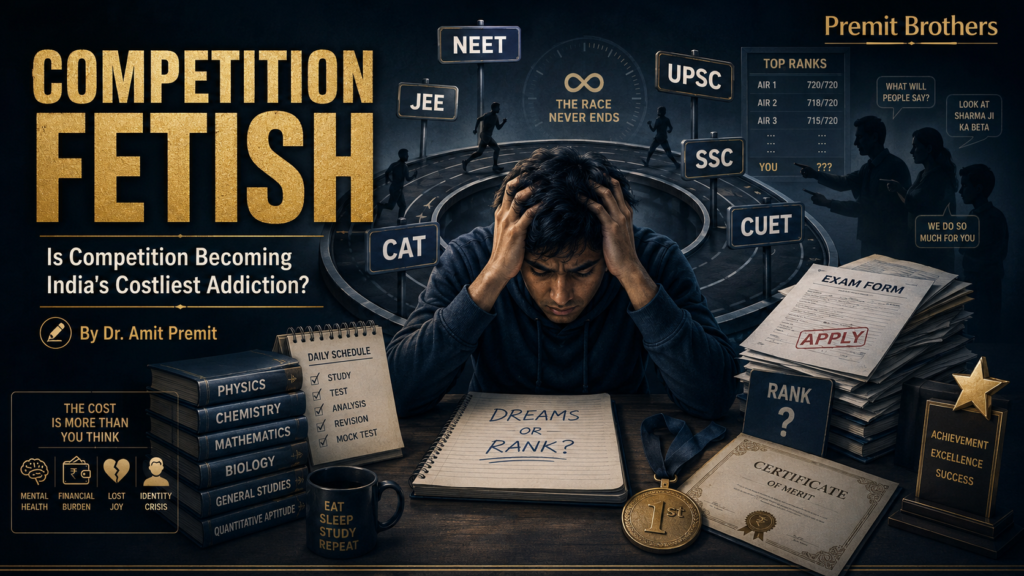
Every year, millions of students across India fill out forms for NEET, JEE, UPSC, SSC, Banking, Railways, CAT, CUET, Olympiads, scholarships and dozens of other examinations. For many families, this process has become a routine—not a conscious career decision.
Competition itself is not the problem. Healthy competition can drive excellence, resilience, innovation and progress. The problem begins when competition becomes our identity instead of remaining a tool.
What is “Competition Fetish”?
It is the obsession with entering, surviving and winning competitions without first understanding whether the race aligns with one’s aptitude, interests, values, personality and long-term direction.
The Medal Economy Starts in Childhood
Children are naturally curious. But adults often convert curiosity into a scoreboard.
Slowly, validation replaces exploration. Learning becomes secondary and winning becomes everything. Marks replace curiosity. Ranks replace learning. Certificates replace capability.
The Validation Conveyor Belt
A simple visual of how external approval can gradually replace intrinsic motivation.
What Does Competition Really Measure?
A competitive examination measures how well a person performed on a particular day, under a particular set of rules, within a fixed time and evaluation system.
Yet society often treats selection as proof of superiority and rejection as proof of failure. That assumption has damaged countless careers and lives.
The Civil Services Story Nobody Talks About
Imagine two aspirants preparing for the same examination.
Clears after twelve years
The achievement is visible. The selection is celebrated. The story becomes inspirational.
Misses by four marks
The ability may be almost identical. But society quickly labels the person a failure.
Almost nobody asks what those years cost emotionally, which opportunities were lost, whether the journey matched the student’s strengths, or whether the goal represented purpose—or only social approval.
India’s Biggest Employment Illusion
One of the most limiting ideas in our education system is the belief that employment and a job are the same thing.
The purpose of education should never be limited to finding employment. Its deeper purpose should be creating value.
The Middle-Class Success Trap
Most parents want security for their children. That desire comes from love. But over time, security became more important than self-discovery.
Socially Approved Success
- A familiar title
- A predictable salary
- A respected examination
- Approval from relatives and society
Strength-Aligned Success
- Work that fits aptitude and personality
- Skills that remain valuable
- Energy, engagement and growth
- Contribution that feels meaningful
Many students spend years preparing for careers that never matched who they truly were.
AI Has Changed the Rules Forever
The future no longer rewards people simply because they hold degrees. It rewards those who can apply knowledge, solve real problems and keep learning.
VALUE
Career Clarity Starts with Self-Awareness
Before asking, “Which competitive examination should I prepare for?”, ask questions that reveal the person behind the application form.
- What problems do I naturally enjoy solving?
- Which strengths make me valuable?
- What kind of work gives me energy instead of only status?
- Where can I create meaningful impact?
The right career begins with self-awareness—not with an application form.
The Premit Brothers Philosophy
India’s future will not be transformed merely by producing more examination toppers. It will be transformed by producing more creators, innovators, problem-solvers and responsible citizens.
Five Questions Every Student and Parent Should Ask
Before preparing for the next competition, pause and reflect:
- If every competitive examination disappeared tomorrow, what value could I still create?
- Am I chasing selection—or building contribution?
- Am I preparing for the right competition—or simply the next one?
- Does my child know their strengths, or only their marks?
- Am I building the ability to work, or only searching for a job?
Final Thoughts: Choose Conscious Competition
This is not an argument against competition. It is an argument for conscious competition.
Choose competitions that align with your strengths. Keep learning where your curiosity leads. Build skills that create value. The purpose of life is not to win every competition. The purpose is to become someone whose work makes a meaningful difference.
Don’t Choose the Next Race Before Understanding the Runner.
Premit Brothers helps students and families understand aptitude, interests, personality, strengths and career alignment—so the next decision is conscious, not compulsive.