
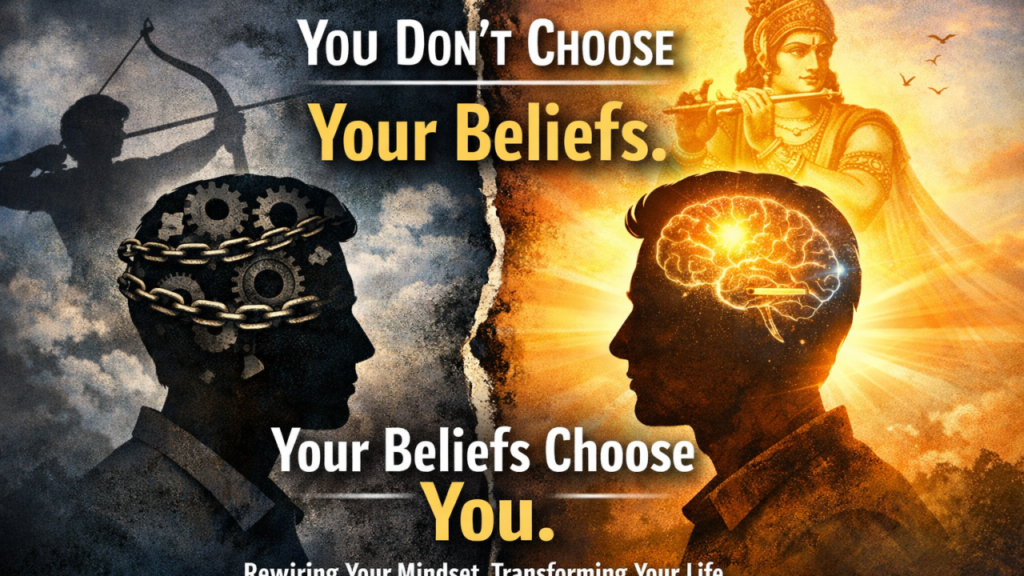
(And that’s why most people fail—they just follow an old blueprint)
Good News You Can Change your Beliefs
Let me ask you something personal—no filters.
Have you ever looked back at a decision and thought: “Why did I do that? That wasn’t even me.”
Or you saw someone else take a bold step and felt that silent pinch inside: “I could never do that.”
If you’ve felt that, you’re not broken. You’re human.
And more importantly – you’re living inside a belief blueprint you didn’t consciously choose.
I’m currently reading The Diary of a CEO by Steven Bartlett , and in Law 4 he says something that can either irritate you or wake you up:
You do not get to choose what you believe.
At first, I paused. Because we all like to believe we are “free thinkers.” But the more I sat with it, the more I realised…
Most of us are not making choices. We’re executing programs.
And the crazy part? We call it “personality.”
Chapter 1: The Illusion of Choice (And Why It Feels So Real)
You wake up. You pick your clothes. You choose your breakfast. You scroll Instagram and think, “I like this content.”
And it feels like you’re in control.
But here’s the uncomfortable truth:
You are not choosing from infinite possibilities. You are choosing from the options your beliefs permit.
Beliefs don’t just influence you. Beliefs filter reality.
You don’t see the world as it is. You see the world as your belief system allows you to see it.
This is exactly what NLP (Neuro-Linguistic Programming) has been saying: Your external life is often a reflection of your internal blueprint.
You think you’re choosing your path. But your beliefs already decided what feels safe, possible, or “for people like you.”
Chapter 2: The Algorithm Knows Your Beliefs (Better Than You Do)
Let me give you a modern example, and trust me – this hits hard.
You believe you’re seeing what you want on Instagram, Facebook, YouTube.
You’re not. Meta and Google don’t show you reality. They show you what your behavior reveals about your beliefs.
You scroll fitness videos? You’ll get more. You scroll fear and controversy? You’ll get more. You scroll luxury and envy? You’ll get more.
Your feed isn’t entertainment.
Your feed is a mirror of your conditioning.
And slowly, it hardens into identity:
“This is what people talk about.” “This is the world.” “This is how life works.”
No. It’s just your belief loop getting better at feeding itself.
Chapter 3: Not All Beliefs Are Bad (Some Saved Your Ancestors)
Now, before we villainize beliefs – let’s be fair.
Beliefs are not “negative.” Beliefs are survival tools.
Ever noticed a baby who just started walking? He sees stairs… and hesitates.
Nobody sat him down and explained physics and gravity. Yet the child senses danger.
That’s inherited survival intelligence.
Your ancestors believed:
- Wild animals are dangerous
- Heights are risky
- Darkness hides threats
Those beliefs kept them alive. And some of that caution lives in you.
So beliefs are not the enemy.
The problem starts when old survival beliefs become modern limitations.
Chapter 4: The Most Dangerous Beliefs Are the Ones That Sound Like “Reality”
These are the beliefs that don’t feel like beliefs.
They feel like facts.
- “I’m not good enough.”
- “I’m not the kind of person who succeeds.”
- “People from my background can’t reach that level.”
- “I’m too late.”
- “It’s not for me.”
And the worst one:
“I can’t.”
Listen carefully: Your capability might be real. Your intelligence might be high. Your potential might be massive.
But belief quietly whispers: “Don’t try. It’s safer.”
In Kuch Kaam Kar Lo, I often say something blunt:
Most people don’t lose because they lack ability. They lose because they obey a belief that told them to stop trying.
Chapter 5: Arjun Didn’t Lack Skill. He Collapsed Under Belief.
Now let’s go Indian – because our best psychology lessons are hidden in our epics.
Before the Mahabharat war, Arjun froze.
He didn’t freeze because he was weak. He froze because his belief system collapsed under pressure.
He started seeing everything through one lens:
- “I will hurt my own.”
- “This is wrong.”
- “I can’t do this.”
Same warrior. Same bow. Same battlefield.
But inside? Belief chaos.
And what did Krishna do?
Krishna didn’t just “motivate” him.
Krishna reframed reality.
He didn’t give Arjun a pep talk. He gave him Gita Gyaan – a blueprint change.
That’s why I say: The Gita is not just spiritual. It is belief rewiring.
When belief changed… action returned.
Chapter 6: The Scar That Wasn’t There (Yet It Ruined Confidence)
There’s a powerful psychology experiment (you may have heard a version of this).
Two groups. One group was shown a “scar” on their face in the mirror. They were told it looked visible.
Then they went into social interactions.
What they didn’t know: Before sending them out, the “scar” was wiped off.
There was no scar.
Yet those participants reported:
- “People were judging me.”
- “I felt inferior.”
- “I wasn’t confident.”
The scar didn’t exist.
But the belief did.
That’s the point: Belief changes your behavior first. Then it changes your interpretation of others. And then it becomes your reality.
Chapter 7: Why Motivation Doesn’t Change Beliefs (It Just Gives Dopamine)
Now here comes the part where many people get offended.
Most motivational content is not transformation. It’s emotional sugar.
It gives you a temporary high. A temporary “I can do it!” feeling.
Then life happens. And the old blueprint returns.
Because belief doesn’t change by listening harder.
Belief changes only when the mind gets new evidence.
And here’s the trap:
If you attack your old belief directly – your brain defends it.
The more you fight it, the stronger it feels.
That’s why people keep saying: “I know what to do… but I just can’t.”
They’re not lazy. They’re loyal to a blueprint.
Chapter 8: How Beliefs Actually Change (A Simple Method That Works)
Here’s the practical, no-drama framework I follow and teach:
1) Identify the limiting belief
Name it. Don’t run.
2) Accept it exists
Not justify it. Not shame it. Just accept: “This is inside me.”
3) Create new evidence
Small proof. Repeatable proof. Belief changes with repeated evidence—not one-time hype.
4) Replace, don’t erase
You don’t delete the old story overnight. You install a new story so strong that the old story becomes irrelevant.
That’s how psychology works. That’s how NLP works. That’s how meditation and many Hindu Sanatan practices work too.
Not by force. By training attention + repeating evidence.
Chapter 9: Your Mentor Matters More Than Your Motivation
Beliefs are influenced by people.
So yes – choose your mentor, therapist, coach, guru carefully.
Not every loud voice is wisdom. Not every viral speaker is a guide.
Scrolling is not growth. Dopamine is not discipline.
The right mentor doesn’t hype you.
The right mentor helps you:
- see your blind spots
- build proof
- practice new identity
- make change sustainable
Final Chapter: You Didn’t Choose Your Beliefs…
But You Can Choose to Question Them
You didn’t pick your blueprint. But you can choose whether you live blindly inside it.
And that’s freedom.
Not freedom to “think positive.” Freedom to think clearly.
So I’ll end with a question – one you should sit with, not answer quickly:
Which belief about yourself have you never questioned…
and what might your life look like if you did?
If this article triggered something in you – good. That’s not discomfort. That’s awareness.
And awareness is where rewiring begins.
Kuch Kaam Kar Lo. Because action changes life… but belief decides what action you dare to take.